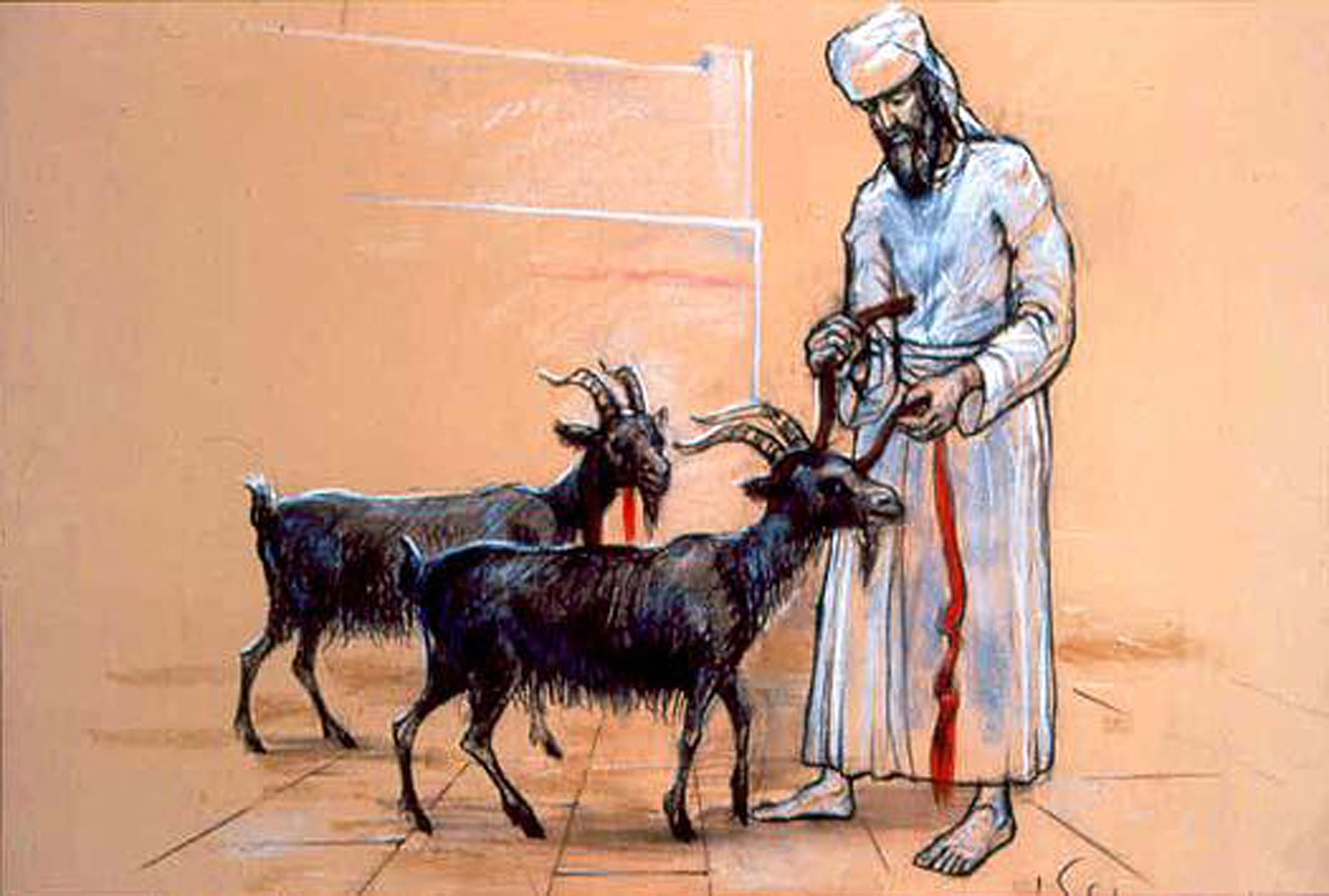
Yom-Kippur Scapegoat1
Feast of Forgiveness
Divine Mercy Sunday
Today we celebrate Divine Mercy Sunday and (later this afternoon / tomorrow) we will complete Our Lord's request in the celebration of the Feast of Divine Mercy. The Feast was made part of the Church calendar by, now Saint, Pope John Paul II in the year 2000. However, even though this was recently declared as Divine Mercy Sunday, it is not a new feast. It is a reinstatement of the feast, Yom Kippur, or the Day of Atonement.
Yom-Kippur Scapegoat1
In this ancient Jewish feast a goat was released in the desert to take away the sins of the people. The Feast of Yom Kippur is similar to our season of Lent in which the Jewish people went through a time of penance and ritual purification before they could participate in the feast. Yom Kippur was the only day of the year in which sins could be forgiven.
The Feast of Divine Mercy, reinstates and expands Yom Kippur, not only by the forgiveness of sins, but by establishing this day in which full reparation can be made to God's justice. Fr. Ignacy Rozycki, the dogmatic theologian who performed a critical analysis of Sister Faustina's diary for the Holy See, says that the celebration of the Feast is greater than a plenary indulgence. On this day “Jesus promised to unleash on the world a flood of mercy.” Note the comparison to the days of Noah where God flooded the world because of the depravity of man's sins, but today, on Divine Mercy Sunday, God sends a flood of grace and forgiveness. Fr. Rozycki continues saying that on the Feast of Divine Mercy, “Jesus raised receiving Holy Communion to the rank of a second Baptism.”1 .
The Feast of Divine Mercy was commanded by Jesus in His appearances to Sister Faustina, a young simple Polish nun. He established this day for the full restoration of our souls. He said, “the soul that will go to Confession and receive Holy Communion [on the Feast of Divine Mercy] will receive a complete pardon of sin and punishment.2 … “Were a soul like a decaying corpse so that from a human standpoint, there would be no [hope of] restoration and everything would already be lost, it is not so with God. The miracle of Divine Mercy restores that soul in full. Oh, how miserable are those who do not take advantage of the miracle of God’s mercy!”3
Not only did Jesus establish the Feast of Divine Mercy, He was very specific about the date - the Octave of Easter Sunday – which would culminate His Passion, Death and Resurrection with the celebration of His Mercy.
On Holy Thursday Jesus instituted the Sacrament of the Holy Eucharist - this great act of Our Lord's Mercy, of which no one is deserving. He did so to lift us up and join our souls with Him. In The Holy Eucharist Jesus created an intimate and divine union with us – what could be more loving - what could be more merciful?
On Good Friday Jesus atoned for our disobedience and injustice. He became the goat, the scapegoat of Yom Kippur, to carry away our sins. Jesus paid the price. Every act in His Passion and Death had the specific purpose of making reparation for our sins. He was stripped to make reparation for sins of immodesty, crowned with thorns to atone for sins of pride, blindfolded to make reparation for those who profane what is holy, handed a royal reed to atone for deeds done with evil intent, slapped for sins of irreverence, and He hugged Judas' feet to make reparation for obstinate sinners. Only Jesus was capable of atoning for our sins. None of us was found worthy of so great a sacrifice. What a great act of Mercy!
On Easter Sunday Jesus rose from the tomb and lifted us from the pit. In His Resurrection and Ascension He defeated Satan. He defeated sin and death, freed us from the hands of evil, and opened the gates of Heaven. He stands before His Father as our Merciful Savior. Jesus made our salvation possible ---- but there was still more to do.
In today's gospel Jesus enters the room where the disciples were and says “Peace be with you.” It was not only Peter that swore he would never deny Jesus - that he would die for Him - all the apostles said the same – yet all but John denied Him. All, save one, deserted Him. In saying, “Peace be with you”, Jesus bestows the peace of forgiveness and grants them absolution.
Before His Passion Jesus said to Simon, “You are Peter, [the] rock, [on which] I will build my church”.4 On the shore of the Sea of Galilee Jesus asked Peter three times, “Do you love Me?” In the same way, in saying “Peace be with you” three times, Jesus in effect ordains the apostles for His mission and establishes their authority in His Church. Jesus said, “As the Father has sent Me, so I send you.” And when He had said this, He breathed on them and said to them, “Receive the Holy Spirit. Whose sins you forgive are forgiven them, and whose sins you retain are retained.”5
In this Jesus establishes the Sacrament of Reconciliation and grants the Apostles, and the Church, the authority to forgive sins. Jesus said to Peter and the apostles, “Feed My sheep”6 That is the mission of the Apostles and the mission of the Church - to feed souls with the gospel, call sinners to repentance, forgive their sins, and restore their relationship with God. Jesus greets His disciples saying, “Peace be with you!” What a great act of forgiveness! What a great act of Mercy!
In this Feast of Divine Mercy Jesus wants us to be at peace. He wants to give us the peace of forgiveness – a full pardon for our sins. This Feast could as well be called the Feast of Reconciliation, the Feast of Forgiveness, the Feast of Restoration, or the Feast of Freedom. Jesus wanted this feast on the Octave of Easter Sunday to celebrate our restoration, and for us, in turn, to rejoice in what the Lord has freely given, to proclaim His goodness, and venerate His Mercy.
Then, in another great act of mercy, Jesus sends the Holy Spirit to be our advocate and establishes His Holy Catholic Church. It is the Holy Spirit that will protect the Church from error, and He gave us His Mother – our Mother of Mercy – as our protector and tender intercessor.
One day Sister Faustina complained to Jesus about her habitual sins - sins she always seemed to confess. Jesus told her, “do not fight against a temptation by yourself, but disclose it to [your] confessor at once, and then the temptation will lose all its force … During these ordeals do not lose your peace; live in My presence; ask My Mother and the Saints for help … Temptation gives you a chance to show Me your fidelity.”7
Did you hear what Jesus said? He said, “go to your confessor at once, and the temptation will lose all its force.“ He said, “Ask My Mother and the Saints for help.” We have always known that Mary points us to Jesus, but here, in Saint Faustina's Dairy, Jesus points us to Mary. If there was ever any doubt about the Blessed Virgin's role in our salvation and her position as Protector of the Church, Jesus' words should alleviate all concerns.
Jesus, also, gave Sister Faustina, now Saint Faustina, a prominent role in the Church and in our salvation. He called her the Secretary of His Divine Mercy. He promised that He would defend anyone she brought to Him. And He gave her the Chaplet of Divine Mercy, a prayer composed by Jesus Himself, to be prayed on His Mother's Rosary. He told Sister Faustina to pray the Chaplet for the sick and dying. In this chaplet Jesus promised to grant anything we ask if it is compatible with God's Divine Will - anything we ask if it is compatible with God's Will.
While Sister Faustina was living in Vilnius, Lithuania, Jesus demonstrated to her the unlimited power of the Chaplet of Divine Mercy through a number of extraordinary miracles and events. He did this to demonstrate the boundless power of this new prayer – that it is a prayer for all mankind and all our needs. On one occasion Jesus asked her to pray the Chaplet for a change in the weather, and immediately on completing the prayer the weather changed and a severe drought ended.8
On another occasion Sister Faustina was bi-located to the bed of a dying sinner. Jesus told her to pray the Chaplet that He taught her. Sister Faustina says, “A multitude of devils was waiting for the soul. But while I was saying the Chaplet, I saw Jesus just as He is depicted in the Image. The rays which issued from Jesus' Heart enveloped the sick man … the powers of darkness fled in panic [and] the sick man peacefully breathed his last.”9
Jesus explained to Faustina that He would grant unimaginable graces to those who prayed the Chaplet. He said, “Even if there were a sinner most hardened, if he were to recite this chaplet only once, he would receive grace from My infinite mercy. I desire that the whole world know My infinite mercy. I desire to grant unimaginable graces to those souls who trust in My mercy.”10
In Sister Faustina's diary we read, “I saw the Lord Jesus clothed in a white garment. One hand [was] raised in the gesture of blessing, the other was touching the garment at the breast. … there were emanating two large rays, one red, the other pale. In silence I kept my gaze fixed on the Lord; my soul was struck with awe, but also with great joy. After a while, Jesus said to me, “Paint an Image according to the pattern you see, with the signature: Jesus, I trust in You. I desire that this Image be venerated, first in your chapel, and [then] throughout the world … I promise that the soul that will venerate this Image will not perish … I Myself will defend it as My own glory.”11
Jesus wants to bestow His grace on us. He wants to set us free! He wants us to approach Him with complete trust. He told His disciples, “If you have faith the size of a mustard seed, you would say to (this) mulberry tree, ‘Be uprooted and planted in the sea,’ and it would obey you.”12 What power Jesus has given us in this Image of Divine Mercy and in this Chaplet! What grace He has bestowed on us! What Mercy He has shown us, in His Passion, Death, and Resurrection, in His Forgiveness, and in pardoning our sins on this Feast of His Divine Mercy! In the Reproaches of Good Friday Jesus asks, “What more could I have done that I did not do?' With all that Jesus has done for us how could a soul not want to venerate His forgiveness and celebrate His Mercy?
References
Images