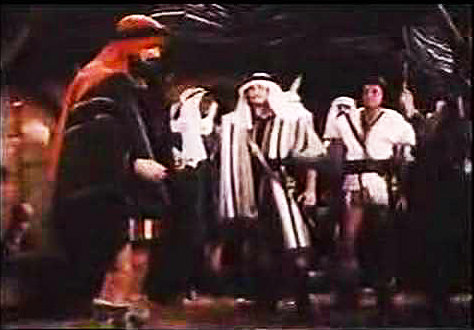
Martydom of Eleazar
by Mel Gibson - The Maccabees Movie 1
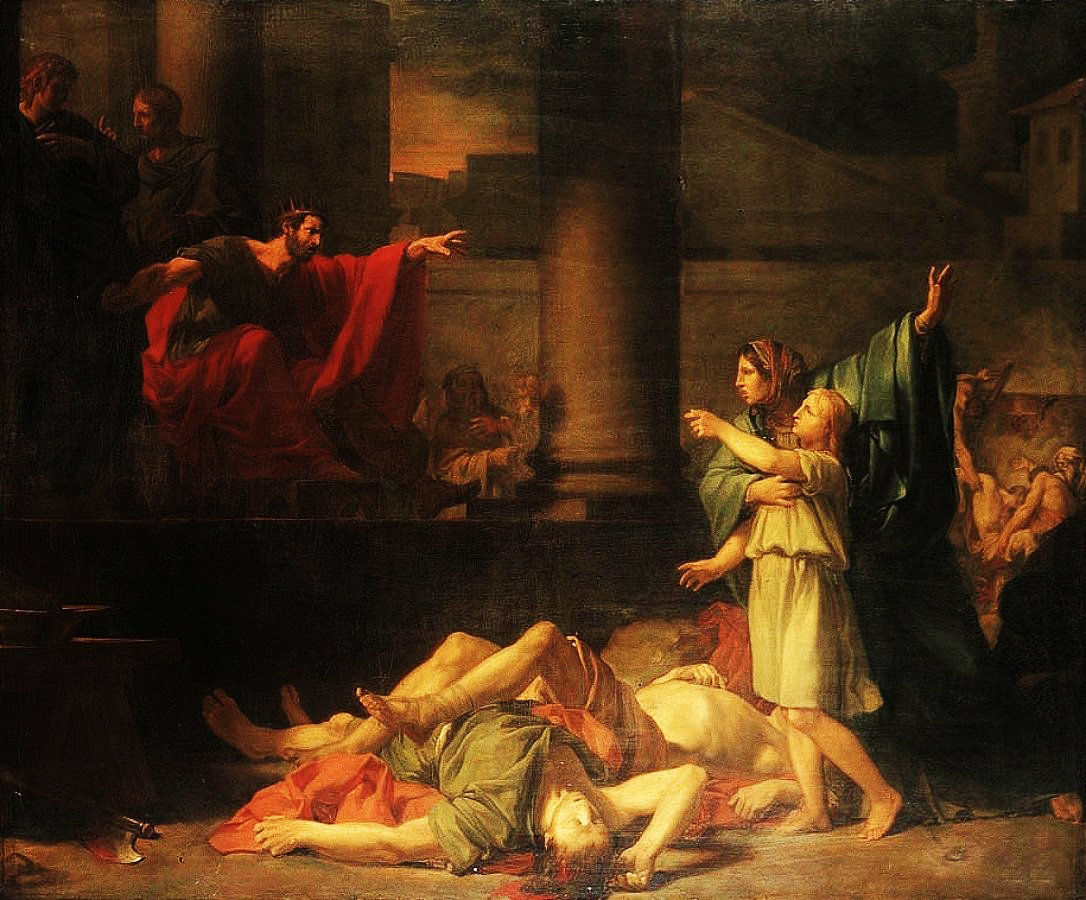
Martirio dei Maccabe
by Jean Baptiste Vignaly 1
The Seven Brothers
There is an old proverb which says, “If we don't live according to what we believe, we will soon believe according to how we live.” This statement presents a profound truth about our fallen human nature and the influence of evil in our society and on our lives. Abandoning our beliefs often occurs as a very subtle and seductive process. The temptation is to modify our principles in order to accommodate our behavior. This proverb challenges us to live lives of integrity – to avoid the seductive power of hypocrisy – and live the beliefs we profess.
In today's readings we hear two stories about seven brothers. In each story the brothers are true to the beliefs they profess. In the first, Seleucus, who was the prefect of Syria was ordered to pay a tax by the emperor. Hearing of a storehouse of silver and gold in Jerusalem, he sends his emissary, Heliodorus, to the Jerusalem to confiscate the treasury (the Temple Treasury was used to provide for the widows and orphans of the Holy City and to support the Temple).
Initially Heliodorus is turned back by a series of miraculous events described in the Second Book of Maccabees, but afterward Jerusalem falls. Forty thousand Jews are killed and another forty thousand are enslaved. Greek gods are placed in the Temple and the Temple is defiled by pagan religious rituals including those utilizing prostitutes. Heliodorus then seeks to complete their conquest to apostacize the remaining faithful Jews by seduction and force.
Martydom of Eleazar
by Mel Gibson - The Maccabees Movie 1
Martirio dei Maccabe
by Jean Baptiste Vignaly 1
After killing Eleazar, a wise man and scribe of the Temple, for refusing to eat pork, Heliodorus' henchmen turn to the seven brothers. Though the Jews were commanded by God not to eat pork, the dietary law was not the real issue for Heliodorus. His objective was the destruction of the Jewish faith.
Today, Christians face similar opposition because the predominant way of life in our society is no longer Christian, and those who live lives opposed to our moral values seek to silence all opposition and criticism. The current persecution of Christians has spread worldwide as evil attempts to apostacize the faithful by seduction, social pressure, and legal maneuvers, or by silencing the Christian voice by force.
These attacks have taken many forms. As an example, one of our current political candidates has said, “religious values in America have to change, and those changes must be accompanied by a change of law.” The candidate was referring to Christian opposition to abortion and same sex marriage. Others have demanded that religious practices should be confined within parish walls, and censored from the public square. Similar advocates have attacked religious freedom, and our freedom of speech, insisting that text of sermons and homilies require prior governmental approval. This are the same tactics used by the Mexican government in an attempt to destroy Catholicism in the 1920's, which led to the birth of the Cristeros rebellion.
Not too many years ago eighty percent of those who identify themselves as Catholic regularly attended Sunday Mass. Today, only eighteen percent do so. Today, the Church's moral teachings are ridiculed and even violently opposed. As a result, many have abandoned their faith. No one likes to be laughed at, no one likes to be ridiculed, no one likes to be excluded from mainstream culture, criticized, labeled or hated. But in the face of these challenges if we lose courage and compromise, we lose the very faith that gives meaning to our lives.
If we don't live according to what we believe, we will soon believe according to how we live. The proverb warns us to be vigilant. The seven brothers understood the danger they faced. They refused to abandon their faith. They refused to adapt to pagan gods. They believed, they knew, that Our Good Lord would raise them up. The seven brothers understood that it was better to die once, to die bravely, true to their faith, than to die in apostasy and cowardice by a thousand cuts.
The second story of seven brothers comes from the Gospel of Luke. In biblical times, up to and including the time of Jesus' ministry, there were various schools of thought on the resurrection of the dead and eternal life. One school of thought dates back to ancient cultures and can be seen in Sacred Scripture at the time of Abraham. For these cultures, including the Israelites, a form of eternal life was achieved through the longevity of the family line: a person lived on through their descendants.
In the Jewish culture, children were a great treasure – they were life itself. The importance of descendants is shown by biblical genealogical lists, in the sorrow of the barren wives, and in the laws of Israel. God said to Abraham, “I will bless you abundantly and make your descendants as countless as the stars of the sky and the sands of the seashore.”2 For Abraham, this was a tremendous gift. It was also a forerunner of the promise of eternal life.
According to the law of Moses, if a man died childless his brother must marry his widow so that the man's descendants would not be lost. Though the story of the seven husbands was exaggerated, it was no doubt practiced in Israel. That the remaining brothers would marry their brother's widow shows the depths of their love for God, their love for their brother, the value of descendants, and their obedience to Mosaic law. In their love and protection of children, Judaism starkly differed from other cultures at the time and from societies today.
The value of children and the protection of life has been a long and continual emphasis of the Church. One of the oldest original documents of the Church, known as the Didache and written around 150 AD, states. “You shall not commit murder, you shall not commit adultery, …you shall not murder a child by abortion nor kill that which is begotten.” Yet, abortions today occur at unimaginable rates. Instead of being seen as a continuation of life itself, children are viewed by many as disposable, as a responsibility to be avoided, or as an impediment to freedom.
If we don't live according to what we believe, we will soon believe according to how we live. We have to wonder, did this holocaust against children begin because people lost their faith, or did they lose their faith because they began to live lustful, self-centered lives? St. Peter tells us, “Be sober and vigilant. Your opponent the devil is prowling around like a roaring lion looking for (someone) to devour.”2
The story of a woman who marries seven brothers, presented by the Sadducees, was intended to ridicule the Pharisees. The Sadducees thought the story so ridiculous that Jesus would be forced to take their side, and denounce the Pharisee's belief in the resurrection of the dead.
Most of Jesus' conflicts were with the Pharisees. They are mentioned directly in Scripture ninety-eight times, whereas the Sadducees are mentioned only eighteen times. In some ways the Pharisees are mis-portrayed. I'm sure there were many Pharisees, like Nicodemus, who sought to live holy and charitable lives. Jesus' principle issue was with their leaders, with His own priests, who lived hypocritical lives – religious posturing, stealing the homes of widows, and their inability to recognize the fulfillment of Sacred Scripture in the coming of the Messiah.
Unlike the Pharisees who were religious leaders, the Sadducees were more concerned with politics than religion. They were aristocrats. They tended to be wealthy and held powerful positions, including that of the high priest. They held the majority of the seventy seats in the Sanhedrin, the ruling council of Israel that condemned Jesus.
The Sadducees did not accept the writing of the prophets or tradition as Divine Revelation. They believed only in the Torah. They did not believe in angels, even though angels are mentioned in the Torah. They did not believe in the immortality of the soul, judgment after death, the resurrection of the dead, or life after death. And, they collaborated with their Roman rulers in an effort to maintain their status. They enjoyed all the pleasures that come with wealth and power.
Given such beliefs, how they lived their lives is not surprising, nor is it surprising today. If there is no judgment and no life after death, then the present life is all they have. There is no reason to live a moral life, except to avoid imprisonment or to gain the esteem of others. Instead of seeking the fullness of Divine Revelation, the Sadducees adopted beliefs that suited their desired lifestyle. And in the story of the seven brothers they ridicule the Pharisees and attempt to manipulate the truth to promote their own lifestyle and welfare. Does this sound all too familiar today? “If we don't live according to what we believe, we will soon believe according to how we live.”
Unlike the intentional anti-religious environment we experience today, the Sadducees were probably only vaguely aware of their faults. Though they were sincere in their beliefs, they were dead wrong. How surprising it must have been when Jesus didn't agree with their point of view. But, such is the nature of sin. The greater the level of sin, the less we are inclined to recognize the evil in our lives.
The story is told of a group of Christians walking along a barren plateau on their way to heaven. They are all carrying large heavy wooden crosses, like the one Jesus carried. Very fatigued, one of them stops, lays down his cross, and turns to God in prayer. "Lord", he says, "I want to follow you, but this cross is just too heavy. Can you please lighten it?"
Hearing no answer, he pulls out a saw and cuts off a foot from the end of his cross. He continues along carrying his customized cross, but it is still uncomfortable, so he stops once again to pray. “Lord, you know that I love you, but I am just not strong enough to carry this heavy cross.” So, he gets out his saw again, and cuts off another couple of feet.
Now smiling, with the lighter load, he continues his journey. All of a sudden he comes to a huge chasm. A deep abyss separates the plateau he is on from the other side, which leads to heaven. He looks around to see that everyone else is laying down their cross and walking on them to the other side. So he lays down his cross to do the same thing. To his horror, he discovers that his cross doesn't reach; it's three feet too short.3
The Sadducees did just that – they cut God down to size. They formed their beliefs according to what suited their appetites. It makes us wonder: did the Sadducees start living worldly, pleasure-centered lives because they had lost faith in the Resurrection, or did they lose faith in the Resurrection because they started living worldly, pleasure-centered lives? By cutting God down to size, they cut themselves off from God and lost eternal life.
Is it possible that some of us have become like the Sadducees? Is it possible, that on the outside we seem to be faithful Christians, when in fact we have cut God down to size and weakened our friendship with Him? We may have done this without even realizing it? The Sadducees fooled others. Perhaps, they even fooled themselves, but they could not fool Jesus.
It's natural for us to want to have a good opinion of ourselves. How often have we heard even the most hardened criminal say, “Deep down, I'm really a good person”. Or, to hear someone say, “I'm really a very spiritual person.” Yet, when asked if they attend church, read the Scriptures, or confess their sins they say, “No, but I'm really a very spiritual person.”
It's natural to think of ourselves in a positive light, but likely we all cut God down to size in various ways. When the rich young man called out to Jesus saying, “Good Master”, Jesus responded saying, “Why do you call me good?”
One of the great gifts of Catholicism is the Sacrament of Reconciliation where we are required to confess our sins, and see ourselves, not as better or worse than others, but trealistically through the eyes of Christ who loves us and wants to save us.
Christ left us the Sacrament of Reconciliation for one simple reason: He knew we would need it. If we aren't making frequent use of the sacrament, it could be a sign that we are drifting away from Christ without even realizing it. The Sacrament of Reconciliation also strengthens us to live holy lives, gives us the fortitude to carry our cross, and it reaffirms the commitment we made at our Confirmation to be soldiers for Christ. This coming season of Advent is a perfect time for our renewal.
Today, when Jesus comes to offer Himself to us once again in the Eucharist, let's accept Him and follow Him with all our hearts. Let us pray to never be separated from Him again. Let us ask for His help in living our faith and to live it courageously. The seven brothers refused to cut God down to size. They knew it was better to die a martyr's death and be received into Heavenly glory, than suffer a death of a thousand cuts in timidity or apostasy.
I'll close with a prayer found in the Book of Maccabees.
May God bless you and remember his covenant with his faithful servants, Abraham, Isaac and Jacob. May he give to all of you a heart to worship him and to do his will readily and generously. May he open your heart to his law and his commandments and grant you peace. May he hear your prayers, and be reconciled to you, and never forsake you in time of adversity.4
Baruch Hashem!
References
Images