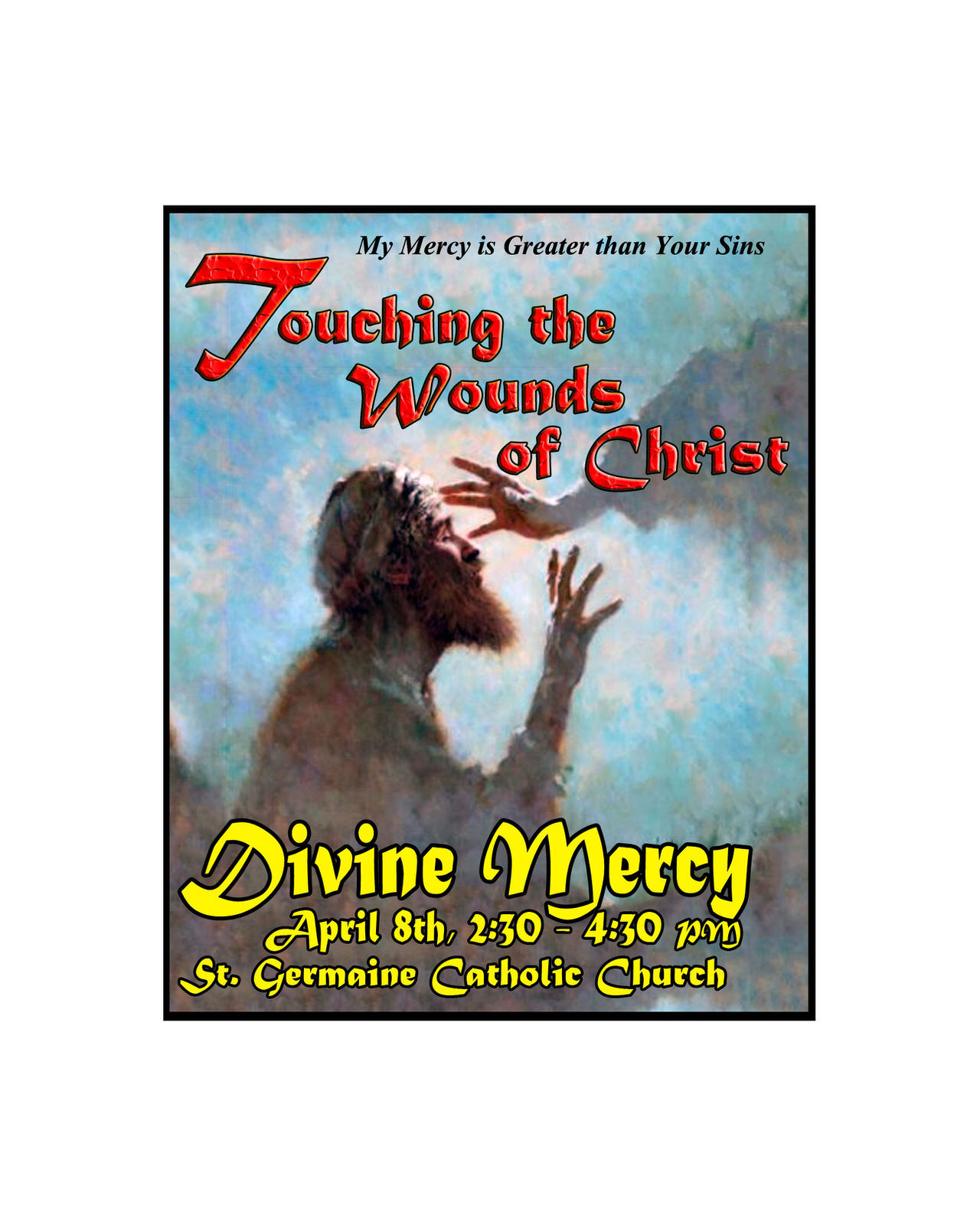
Touching the Wounds of Christ
Feast of Divine Mercy Celebration
We began Holy Week recalling our Lord's Passion and Death. We heard the cries, “Crucify Him”1 , “We have no king but Caesar” 2 , and “[Let] His Blood be upon us and upon our children.”3 In these cries we witness the apostasy of the Jewish authorities and all who turned their backs on their covenant with God. First, in a rigged trial, held in secret at midnight, they condemned an innocent man. Then they disavowed their Lord, and swore allegiance to the Roman Emperor saying, “We have no king but Caesar”. And finally, they said, “[Let] His Blood be upon us”, and thereby released Pilate from their political snare and ensured a guilty verdict.
But it is not just the sins and apostasy of the Jewish authorities that brought about Christ's death. Christ's crucifixion and death functions like a theological DNA test, where spiritual forensics can detect even the tiniest amount of blood. 'Let His Blood be on us' has two meanings. On the most obvious level it signifies blame. We, often, speak of a guilty person as having 'blood on his hands'. But it was not just the sins of the Jewishs authorities that put Jesus on the cross. Jesus died for all of us. Our sins put Him on the cross. Who among us can say that he is innocent? Who among us can say that Christ's Blood is not on our hands?
None of us are innocent of the charges. Christ's Blood testifies against us. We are left with only one option. We have only one way out. And that is to confess our guilt, turn to righteousness, offer our Lord's Passion in atonement for our sins, and plead for His Mercy. Yes, His Blood is on our hands. But, in Our Lord's Great Mercy, the Blood that testifies against us, the Blood that proves our guilt, becomes the Blood that transforms, the Blood that redeems and saves.
Jesus said to Thomas, "Put your finger here and see My hands, and bring your hand and put it into My side, and do not be unbelieving, but believe."4 So, let us join with Thomas. Let us put our hands into His side and believe. Let us touch the wounds of Our Lord and Savior. For it was through the lance that pierced Our Savior's Sacred Heart, that the curtain of the temple was torn in two, and we gained access to the Holy of Holies. Through the Blood and Water that came from His side, forgiveness flows. Through the thorns that pierced His brow, we are crowned with Him as priest, prophet, and king. And, hanging by the nails that pierced His Sacred Hands, in His dying breath, He said, “It is finished.” 5
And on this day, this Day of Mercy, we are pardoned. We are set free – free from all our guilt and shame, and immersed, baptized, born again in the Blood of the Lamb. “It is finished.” The Gates of Heaven are opened, and we are resurrected to new life. Yes, it is finished. It is accomplished. And, it was all done for us.
Jesus told St. Faustina, “Before I come as the just judge, I come as the Merciful Savior.”6 So, let us join with Thomas and touch the Wounds of Christ. Let's us put our hands into His side and believe. Jesus comes to us. We see the nail marks in His hands and feet, and touch the wound where a spear pierced His side. Then we hear His greeting, not words of accusation, not words of condemnation, but words of comfort and forgiveness. He says, “Peace be with You. 7
Our Lord is telling us that this is the time of mercy. This is the time of forgiveness. This is the time of restoration. And today, on this day, the Octave of Easter, we celebrate that great accomplishment: Christ's victory on the Cross. We celebrate, in a Feast, our Lord's great act of Mercy – a joyous Feast requested by our Lord. Christ comes to us. He says, “Put your hands into [My] side … and believe.” 8
And, how do we touch the Wounds of Christ? Pope Francis answers, “[You will] find Jesus’ Wounds in carrying out works of mercy toward your wounded brother, because he is hungry, because he is thirsty, because he is naked, because he is humiliated, because he is enslaved, because he is incarcerated, because he is in a Flovehospital. These are the Wounds of Jesus today.”9 “Just like Thomas was transformed by the Love of God Who is rich in mercy, we are also called to contemplate the Divine Mercy of Jesus that is found in His Wounds. Mercy 'overcomes every human limit and shines on the darkness of evil and sin.'”10
We touch Our Lord's Wounds by proclaiming His Mercy and bringing the hope of relief and redemption to those most in need. Jesus said to Faustina, “I desire that there be a congregation which will proclaim God’s Mercy and, by its prayers, obtain [mercy] for the world”11 . Jesus isn't asking for a Holy Order. He's asking you to proclaim His Mercy, to be His Apostle of Mercy. He says, “tell the whole world about My inconceivable Mercy. I desire that the Feast of Mercy be a refuge and a shelter for all souls, and especially for poor sinners. On that day the very depths of My tender Mercy are open. I pour out a whole ocean of graces upon those souls who approach the font of My Mercy.” 12 “Let the greatest sinners place their trust in My Mercy … Souls that make an appeal to My Mercy delight Me. To such souls I grant even more graces than they ask … I cannot punish even the greatest sinner if he makes an appeal to My compassion.” 13
So, let us say, 'Let us His Blood be on us', in a new way, that we may be made clean - washed in the Blood of the Lamb. Let His Blood be on our conscience, as we confess our guilt, cleanse our souls, and immerse ourselves in the ocean of His Mercy. Let His Blood be on our thoughts, as we proclaim His Word and bring salvation to a lost world. Let His Blood be on our hands as we extend His greeting of peace. Let His Blood be on our lips as we drink from the cup of salvation. And let His Blood be found on our souls when death knocks at our door. Then when our journey has ended, let His Blood be on our hearts that we may enter the gates of paradise and hear the words we long to hear, “Well done, My good and faithful servant … Come, share your master’s joy.” 14
Baruch Hashem
References