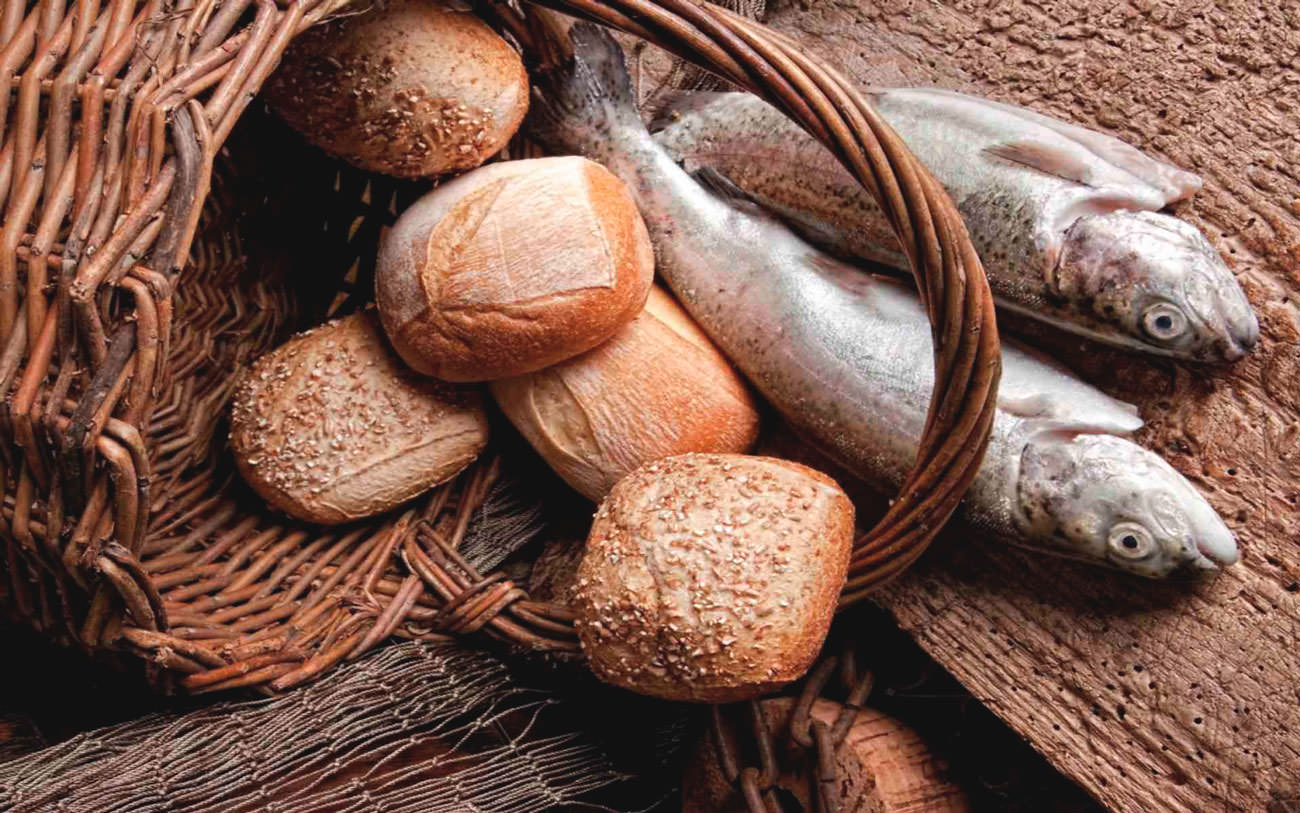
Loaves and Fish
Artist: Unknown 1
Loaves and Fish
Artist: Unknown 1
The State of Our Spiritual Life
Today, and for the next four Sundays, the Church turns to the 'Bread of Life Discourse', in the Gospel of John. In this chapter, Jesus' feeding the multitude, prefigures the Institution of the Holy Eucharist which will occur at the Last Supper - just prior to His death on the Cross.
It is my hope that in the readings for this Sunday, and the following Sundays, that all will come to recognize, believe, and commit themselves to their deeper sacramental meaning. These are stories of miracles: confirmation for those who believe, and a stumbling block for those who fail, or refuse, to recognize their sacramental nature.
Stories, such as these, are referred to as 'precursors'. Our Good Lord fully understands our human nature. He calls us to have faith, but He doesn't call us to an unreasonable faith. These precursors enable us to better understand the mysteries of God, and open our minds to His wisdom and gifts.
The teaching of the Church regarding the Holy Eucharist is among the most fundamental beliefs of our Catholic Faith. It is so central to our faith that the Church says the Eucharist is the source and summit of our Faith, and that all spiritual good comes from, and returns to, the Holy Eucharist - which is Christ.
Earlier I voiced my hope that all would read these stories, and discover their deeper meaning. Sadly, however, for many Catholics that is not the case. Current polls agree that only twenty-two percent of baptized Catholics regularly attend Mass. A recent Pew Research Poll has found that among all Catholics, seventy percent do not believe in the Real-Presence of Christ in the Eucharist.
Additionally, and perhaps, even more alarming, the Pew Research poll has found that thirty-seven percent of those who regularly attend Holy Mass, do not believe in the Real-Presence. And that percentage increases in samples of millennials and younger populations.
While some may look at this data and conclude that the Church needs to better educate its parishioners, I would agree and disagree. The Church always needs to look at ways to better ways to proclaim the message of salvation, but I have never known the Church to be lax in teaching fundamental doctrines. For many, it is not a matter of education. It is a refusal to allow the influence of the Holy Spirit into their lives.
Generally we need to be very careful regarding religious polls. Polls that sample all Catholics produce dramatically different results versus polls that sample those who regularly attend Mass. And while various polls may accurately report trends, they generally do very little to address the underlying causes.
For example, are the Catholics sampled in full agreement with the Doctrine of the Church? Or, are they at odds with the Church's teaching on abortion, annulments, chastity, cohabitation, contraception, confession, marriage, the priesthood, or any of a number of other issues?
If a person is at odds with the teachings of the Church, it's only a short step to abandoning the Catholic Church, falling prey to false doctrines, and shutting off educational avenues. And it's not that the Church has failed to address these underlying issues, it more like the old saying that you can lead a horse to water, but you cannot make him drink.
For me, before I became Catholic, the Real-Presence of Christ in the Holy Eucharist was explained to me. Despite sound instruction I found it difficult to comprehend, and difficult to understand why it was so important. God, however, was in the process of preparing me for what would later come, overcoming every obstacle and opening every door.
Then one day, I was shown pictures and documented evidence of the Miracle of Lanciano. Seeing that was all the proof I needed. To briefly summarize the story, a priest of Lanciano was plagued by doubts about whether the bread and wine actually changed into the Body and Blood of our Lord. As he was offering the Holy Sacrifice of the Mass, when he pronounced the Words of Consecration, the host miraculously changed into Flesh and the wine into Blood. The priest was awestruck. Weeping joyously, after he regained his composure, he confessed his doubt, and summoned those present to the altar to witness what had happened and to "behold the Flesh and Blood of our Most Beloved Christ.”1
Scientific investigations over the centuries, including a recent analysis by NASA, have determined that the blood is human blood – type AB, and that the flesh is the muscle of a human heart. That the Blood and Flesh have not deteriorated in the last 1400 years is a miracle in itself. No preservatives were found in the Blood. The Blood is the same type as found on the Shroud of Turin. Proteins were found in the Blood in the same quantity and substance as fresh blood. Our Good Lord provides us with enough evidence to believe. And this Eucharistic miracle is not unique. The question is: Do we believe? Will we believe?
In today's readings, the man from Baal-shalishah, and Philip and Andrew, are all in a similar position. They are asked to feed a multitude of people with little or no resources. Philip analyzes the situation, concludes that it is impossible, and does nothing. Andrew, as well, sees the situation as impossible, takes a meager step in the right direction, but discounts its value. Scripture tells us that Jesus knew what He was about to do. He wasn't asking for a logistics report, nor some grand design to feed the poor. He wanted to see if Phillip and Andrew, like the man from Baal-shalishah, would turn to Him in a simple act of faith and trust!
The problem with those who deny Christ's Presence in the Holy Eucharist is not generally a matter of education. The evidence is there. The question is a matter of trust. Do we trust Jesus? Do we trust His Word? Jesus has told us, and continues to tell us, “This is My Body … This is My Blood.” 2 “Do not work for food that perishes but for the food that endures for eternal life, which the Son of Man will give you.”3 “The bread of God is that which comes down from heaven and gives life to the world.”4 “I am the bread of life.”5
Given this explicit declaration, and the many documented miracles, the question arises. “Why have so many Catholics abandoned the Church? And why do a significant number of Catholics who regularly attend Mass deny the Real-Presence of Christ in the Holy Eucharist?
To my mind, there are three fundamental behavioral issues in play.
The Eucharist, like the Word of God, is a two edged sword. Eventually, we will choose to believe, or to deny. This leads to a more fundamental, question, 'And that is: 'Why is believing in the Real-Presence of Christ in the Eucharist so important?' In answering this question, I sought additional input from several of my clerical colleagues. I present for you a brief summary of their insights.
Deacon Dale Avery Replied:
God the Father could have chosen a different way to manifest His love for us. He was not constrained to act in a particular way. He chose to send His Word into the world and to offer His Son, the Word Incarnate, as a sacrifice on our behalf … God chose to make Jesus present in the Most Holy Eucharist - Body, Blood, Soul, and Divinity. The more we dwell on that, the more powerful the Sacrament will be in transforming us.
Fr. Dan Vollmer Replied:
Our belief in the Real-Presence of Christ in the Eucharist is uniquely Catholic. It is at the core of our identity and that which separates us from all other religions. In our belief we continue to fulfill what Christ began in establishing His Holy Church.
And, the reality of the Eucharist, Christ seeking union with us, also affirms the goodness of God. Jesus wanted to remain with us until the end of the age, so His Real-Presence in the Eucharist affirms that Jesus is true to His Word.
Fr. Fred LeClaire Replied:
The Real-Presence is important to make Jesus real. His Life, His Death, and His Resurrection. He was a man like us in all things but sin. … His Presence in the Eucharist lets us know that He is fully God and man, and that we are being saved by God and man in a real death and resurrection.
The Blood of the Covenant is eternal in Jesus' offering of the self. Something has to be real to have value, to have meaning. Value means you pay the price. There is a big difference between buying jewelry from Walmart and Tiffany's. Today, people want the Tiffany value at the Walmart price.
The Eucharist is real to make our commitment real, our dying to the self real, our new life in Jesus real. Too many people today live a symbolic reality in their faith. They claim to be a "nice" person, but never realize holiness or virtue. If Jesus chooses to make Himself real so that we can enter His life fully, then why would I reduce this to a symbolic understanding?
Are our sins symbolically forgiven in the confessional? Are we symbolically baptized into Christ? If marriage is only symbolic, then what is the problem of living together or adultery? … It is easier to make it symbolic and believe the way you want, so you don't have to carry your cross and follow Him.
I believe that people want to move away from the Real-Presence in the Eucharist so they do not have to die to self. They want to do what they want to do and still want go to heaven. The Eucharist is to transform us. It is not a reward because you think you are good. It calls us to enter into the full life of Christ, the parts we don't like as well as the ones we admire.
And to these very astute insights, I would add.
In the Eucharist we participate in a supreme, and unequaled way, in the Divine Life of Christ. And as we partake of the Word made Flesh, it is important that we not do so casually, but do so in a full awareness and appreciation of the importance of the Gift that has been given to us. For me, it's a simple matter of faith and trust. The Eucharist is the real Body, the real Blood, the real Soul and Divinity of Christ because Jesus said so. That's enough for me. Perhaps, it's enough for you.
Baruch Hashem!
References
Images