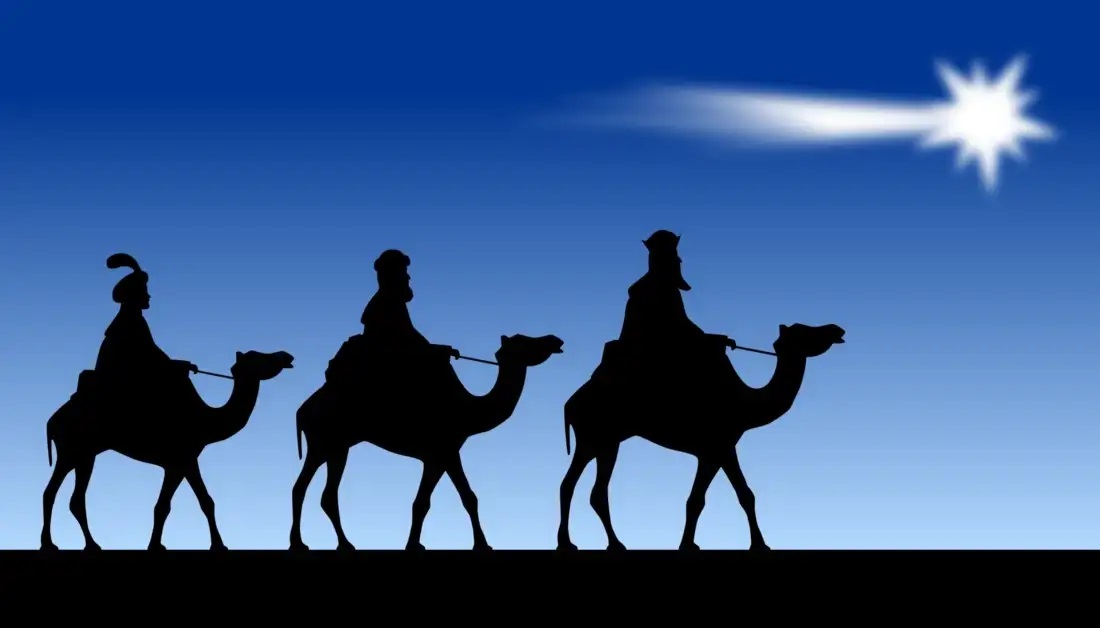
The Three Wise Men
Image by: Unknown 1
The Three Wise Men
Image by: Unknown 1
Encountering Christ
Today, we celebrate the Feast of the Epiphany. We often say, “I've had an epiphany”, meaning that we have seen something from a new perspective, or come to a new understanding. Our coming to a new and deeper understanding is definitely the purpose of an epiphany, but in the sense that we celebrate today, it is also a divine exchange between God and man.
The Feast of the Epiphany generally refers to the visitation of the Magi, or the visitation of the shepherds, but many other events could certainly be categorized epiphanies. At age twelve Jesus explained astronomy, architecture, agriculture, geometry, mathematics, medicine, and law to the temple scholars. Then He so skillfully correlated these subjects with the promises, prophesies, and mysteries of their religion, its ceremonies, and sacrifices that they were astounded and embarrassed. Or Jesus being transfigured and appearing with Moses and Elijah on the mountain. Or Jesus asking, 'Who do you say that I am?', on the road to Jerusalem.
All of these are epiphanies. All of these reveal who Jesus is, and in revealing who Jesus is, they reveal God the Father to us. Jesus' entire life on earth was an epiphany. His sole purpose was to bring us hope and truth, to forgive our sins, and manifest His Father's Love for us.
The Magi came to Jesus following a star. We are told that they came from distant lands. In the Psalm we read, “every nation on earth will adore you”. In Isaiah, “the wealth of nations shall be brought to you ... {and] all from Sheba shall come bearing gold and frankincense, and proclaiming the praises of the Lord.”
Many Jews fled to foreign lands before Israel's captivity in Babylon. It is possible, even likely, that the prophecy about a King, a Messiah, to be born, was known to the Magi. In the Book of Micah we read, “But you, Bethlehem-Ephrathah too small to be among the clans of Judah, from you shall come forth for me one who is to be ruler in Israel; Whose origin is from of old, from ancient times.”1
Motivated by God, the ancient writings, and in the stars, they came in search of the truth. And they came bearing gifts: gold, frankincense, and myrrh. The gifts denote the three offices of Christ: priest, prophet, and king. A gift of gold is not unusual. It is a tribute normally given to a king. It's also not unusual that Frankincense, a type of incense, would be offered to a priest.
Myrrh, however, is a most unusual gift. It was used in embalming. Christ was offered myrrh on the cross, and Nicodemus anointed Jesus with myrrh in the tomb. Myrrh represents the prophetic Office of Christ. It represents suffering and death. We don't know if the Magi understood this. But if they did, their understanding certainly exceeded many in Israel who expected the Messiah to be a military ruler.
This story, like many others, may leave us with as many questions as answers. History provides little information about the Magi, and a wealth of conjecture and contradictions. What we are left with remains largely a matter of faith. But, what is common in these stories is not history, the past or the future, it is the work of Divine Life.
One advantage in not knowing more factual information is that it allows us to more easily place ourselves in the story. However, knowing the Magi's past and future is not critical to our understanding. What is important is the moment they encountered the Christ. What is truly important in our lives are the moments we encounter Christ.
Isaiah says of the child Jesus, “the wealth of nations shall be brought to you … proclaiming the praises of the Lord.” Jesus' entire life, His entire existence, is an epiphany. Our lives are a response to those epiphanies. And, our responses are a manifestation of who we are, what we believe, and what we will become.
In a similar way, the errors of our past are unimportant. What matters is our encounter with the Infant in the manger! What matters is our response to the man who fed the five-thousand and brought the dead to life. What matters is our response to the man who died on the Cross.
Our purpose is to unfold these epiphanies, to follow Him, to live in His Divine Will, and reveal the love of the Christ to others.
In a larger perspective, and perhaps an epiphany for us, we are the gifts of the Magis. We are gifts to the Christ. We are the gold, the frankincense, and the myrrh. We are, as believers, as disciples. the priests, prophets, and kings dedicated to Him in love and service. Past, present, or future; sinner or saint, there is only one thing that matters: our encounter with Christ!
Baruch Hashem!
References
Images