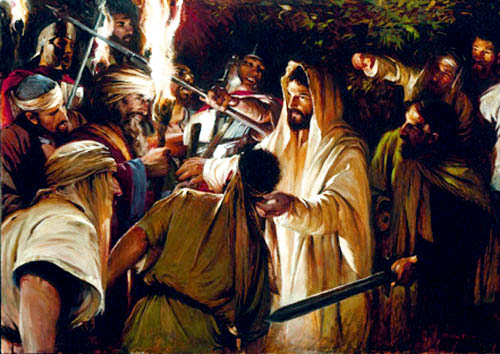
Arrest in the Garden
Image by: Unknown 1
The Temptation of Love
Arrest in the Garden
Image by: Unknown 1
In last week's Gospel, Jesus asks, “Who do you say that I am?”1 . Peter replies, “You are the Christ, the Son of the living God.”2 But, as Peter and the other Apostles would soon discover the question goes far deeper than revelation, far deeper than belief, and far deeper than anything they ever imagined.
From Peter's words and Jesus' response, the disciples now know unmistakably that Jesus is the Messiah, but they still haven't grasped it's meaning. They were thinking of a conquering Messiah, a military warrior king, who would defeat the Romans and lead Israel to freedom.
So Jesus began to teach them that the only way forward was the way of the Cross. He tells them that He must go to Jerusalem to “suffer greatly from the elders, the chief priests, and the scribes, and be killed, and on the third day be raised.”3
Peter immediately responded in love. He took Jesus aside and began to rebuke him, “God forbid, Lord! No such thing shall ever happen to you.”4 Peter places a protective arm around Jesus, as if to hold Him back from a suicidal course. In reply, Jesus says,
“Get behind me, Satan! You are an obstacle to me. You are thinking not as God does, but as human beings do.”5
Jesus's reply was like a man wounded to the heart. After three years, Peter, and the disciples, still did not understand. They knew that Jesus could lead the disciples into battle, or gathered an army, or call down a legion of angels, or simply say the word and avoid the Cross.
The situation is almost a carbon copy of when Jesus was tempted in the desert. Satan tried to persuade Jesus to take the easy way out. He urged Jesus to compromise, to relax His standards. Now, in the Garden of Gethsemane, Jesus and Peter face the same temptation. Jesus acts according to His Father's Will. Peter, however, takes charge. He acts on his own initative. He responds with violence. He draws his sword and cuts off the ear of the high priest's servant.
Again, in sorrow, Jesus rebukes him. Peter still does not understand the Way of the Cross. Satan is any force which seeks to deflect us from the way of God, from the Way of the Cross. Peter does not comprehend that Jesus came, not for armed conflict, not to destroy life, but to give us an abundant life of inner harmony and peace.
"What made the temptation more acute was the fact that it came from one who loved him. Peter spoke as he did only because he loved Jesus so much that he could not bear to think of him treading that dreadful path and dying that awful death."6
What really wounded Jesus’ heart, and what really made Him speak as He did, was that the tempter spoke to Him that day through the love of His friend. This is why Peter’s ideas were human and not of God. What Jesus was saying to Peter is, “Peter, your place is behind Me, not in front of Me. It is your place to follow Me in the way I choose, not to try to lead Me in the way you would like Me to go.”7
In the desert, after the Temptations of Christ, Satan was banished from the presence of Christ. Here, however, Peter is forgiven and recalled to fellowship. This brings us to a most important point. So long as a man is prepared to follow Christ, even after he has fallen into grave sin, there is still hope. He can still be raised to glory, here and in the hereafter.
Then Jesus said to His disciples: “If anyone wishes to come after Me, let him deny himself, and take up his cross, and let him follow Me”8 . The Biblical scholar William Barkley notes: there are three things which a man must be prepared to do, if he is to live the Christian life.
1. He must deny himself. To deny oneself means in every moment of life to say no to self and yes to God. To deny oneself means to obliterate self as the dominant principle of life, and to make God the ruling principle, the ruling passion, of life. A life of constant self-denial is a life of constant assent to God.
2. He must take up his cross. The Christian life is the life of sacrificial service. St. Luke, with a flash of sheer insight, adds one word to this command of Jesus. He says, “Let him take up his cross daily.” The really important thing is not the great moments of sacrifice, but a life lived in the constant awareness of God's Will, and the needs of others.
3. He must follow Jesus Christ. That is to say, he must seek to render to Jesus Christ a perfect obedience. The Christian life is a constant following of our leader, a constant obedience in thought, word, and action to Jesus Christ. The Christian must walk in the footsteps of Christ, wherever that may lead.9
The Christian life may seem difficult, and we may be tempted, in many ways, to take the easy way out. We may think that we can half-heartedly follow Jesus, We make think we can just do the minimum required. But, to do so, would be indicatative of the most superficial of relationships. To do so, would mean that we have no real love of Jesus at all.
We are often tempted, or pressured, to relax our principles, to compromise our values, and find an easy way out. But as Christians, as Catholics, there are principles where no compromise is possible. We cannot be faithful and compromise our views on the sanctity of life, on religious freedom, on the sanctity of marriage, or on any of the Divine Principles of our faith.
Rather, as Christians we are required by our love of God to promote Our Lord's principles, and to defend His values. A person who does not adhere to values of Christ is, in fact, not Christian at all. Jesus says, “If you love me, you will keep my commandments.”10
Fr. Hulong, who founded the Missionaries of the Poor, once said, “Living the Christian life is the easiest thing a person can do.” In view of all the difficulties of life, how can he say this? He knows that there is a peace in following Christ, which comes from an integrity of purpose and spirit. The more we refute sin, the more we grow in grace. Even though times may be difficult, we are strengthen by our fidelity, and sustained by God's Blessing. True, and lasting, peace comes only through unity with God. The joy we seek comes not in the trivial, not in the temporary, but in complete trust – a trust focused on the heart of Christ. We must always remember. We must always trust. We must always beleive that all things are possible in Christ
Baruch Hashem!
References
Images