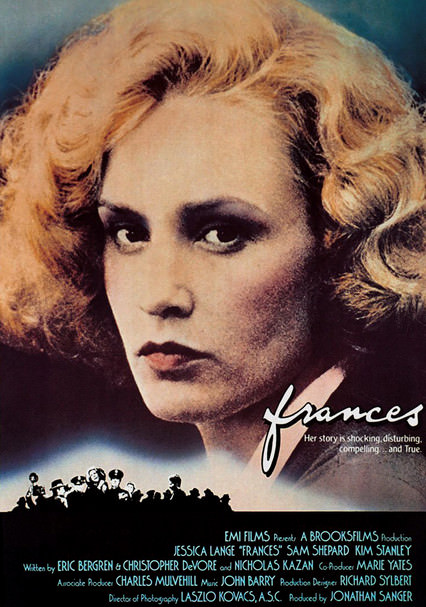
Frances
Director: Graeme Clifford
Cast:
Frances is a 1982 American biographical drama film directed by Graeme Clifford from a screenplay written by Eric Bergren, Christopher De Vore, and Nicholas Kazan. The film stars Jessica Lange as Frances Farmer, a troubled actress during the 1930s whose career suffered as a result of her mental illness. It also features Kim Stanley, Sam Shepard, Bart Burns, Jonathan Banks, and Jeffrey DeMunn in supporting roles.
The film chronicles Farmer's life from her days as a high school student, her short lived film career in the 1930s, her institutionalization for alleged mental illness in the 1940s, her deinstitutionalization in the 1950s and her appearance on This Is Your Life.
Frances was released theatrically on December 3, 1982 by Universal Pictures. Lange's performance was unanimously praised and has been cited by many (including her) as her best performance. At the 55th Academy Awards, it received two nominations for Lange and Stanley as Best Actress and Best Supporting Actress respectively.
Born in Seattle, Washington, Frances Elena Farmer is a rebel from a young age, winning $100.00 in 1931 from The Scholastic Art and Writing Awards for a high school essay called God Dies. In 1935, she becomes controversial again when she wins (and accepts) an all-expenses-paid trip to the USSR to visit its Moscow Art Theatre. Determined to become an actress, Frances is equally determined not to play the Hollywood game: she refuses to acquiesce to publicity stunts, and insists upon appearing on screen without makeup. She marries her first husband, Dwanye Steele, despite being advised not to, but cheats on him with alleged Communist Harry York on the night of her hometown's premiere of Come and Get It. Her defiance attracts the attention of Broadway playwright Clifford Odets, who convinces Frances that her future rests with the Group Theatre.
After leaving Hollywood for New York City and appearing in the Group Theatre play, Golden Boy, Frances learns, much to her chagrin, that the Group Theatre exploited her fame only to draw in more customers, replacing her with a wealthy actress for her family's needed financial backing for the play's London tour, and Odets ends their affair upon his wife's upcoming return from Europe. Her desperate attempts to restart her film career upon returning to Hollywood results in being cast in unchallenging roles in forgettable B-films. Her increased dependence on alcohol and amphetamines in the 1940s and the pressures brought on her by her wannabe mother, who becomes her legal guardian after her multiple legal problems, result in a complete nervous breakdown. After her first hospitalization at Kimball Sanitarium in La Crescenta where she was forced to undergo insulin shock therapy and hydrotherapy, she tells her mother that she doesn't want to return to Hollywood but instead wants to live alone in the countryside, assaulting and threatening Lillian in the resulting argument. While institutionalized at Western State Hospital, Frances is abused by the powers-that-be: she is electroconvulsive shock therapy, is cruelly beaten, periodically raped by the male orderlies and visiting soldiers from a nearby military base and involuntarily lobotomized before her release in 1950.
In 1958, Frances is paid honor on Ralph Edwards' This Is Your Life television program, which Harry York watches from his home. When asked about alcoholism, illegal drugs and mental illness, Farmer denies them all and says, "If you're treated like a patient, you're apt to act like one". The film ends just after a party honoring her at the Hollywood Roosevelt Hotel with Farmer walking down a street with Harry York, talking about her parents' deaths, how she sold their house and that she's a "faceless sinner" with a slower paced lifestyle ahead of her in the future. The end credits state that she moved to Indianapolis shortly afterwards, hosting a local daytime TV program (Frances Farmer Presents) from 1958 to 1964 before dying-as she lived-alone on August 1, 1970 at age 56. 1
References